 Documentation
Execution Flow
The following figure shows the end-to-end workflow of quantum computing tasks in the Pilot system.
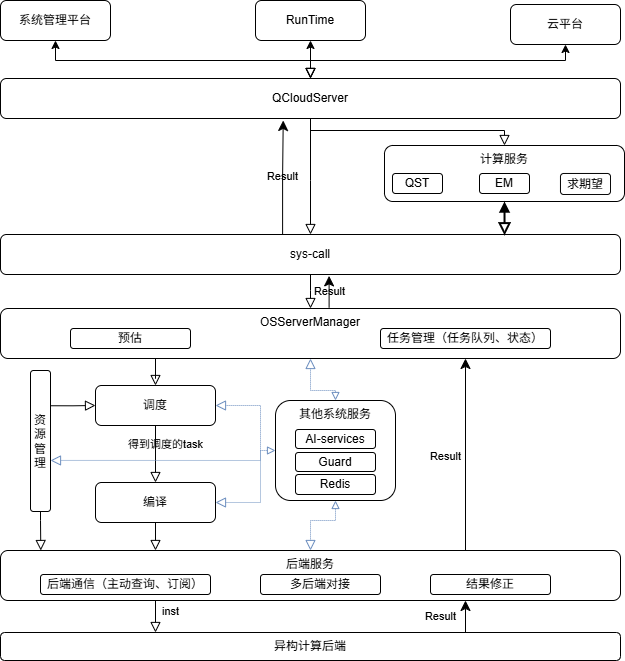
Task Submission: Users can submit quantum computing tasks through the following methods:
QPandaLite: A Python SDK built on top of the Pilot Web management interface (via Nginx service);
PilotOSMachine: Available in Python and C++ versions;
Origin Cloud Platform: A public HTTP API for external access.
All tasks are received and managed persistently by the QCloudServer layer.
Task Preprocessing and Routing: For specialized tasks (such as QST, Expectation Estimation, EM Computation), QCloudServer forwards them to dedicated computing services for preprocessing before calling the Pilot kernel through the system API.
Task Orchestration in Pilot:
The OSServerManager module acts as the central coordinator, managing internal modules and maintaining task queues.
The status of each task is tracked through a shared state mapping table. As tasks flow between modules, their status updates are aggregated in OSServerManager.
After a task is completed (success, failure, or cancellation), all status data is transferred to QCloudServer for persistent storage and removed from OSServerManager—ensuring that OSServerManager only retains the status of active tasks.
OSServerManager also provides resource estimation functionality, predicting the required number of qubits, circuit depth, and runtime to support scheduling decisions.
Scheduling: Estimated tasks enter the scheduling queue. The scheduler allocates resources based on:
Task resourc / execution time requirements;
Current backend availability.
Supported strategies include:
First-Come, First-Served (FCFS);
Highest Response Ratio Next (HRRN).
These can be configured through Pilot’s configuration files.
Compilation and Execution: Scheduled tasks are compiled into backend-specific instructions through optimization channels. The backend service then:
Distributes the task to the target quantum hardware (supporting multiple architectures);
Obtains results and backend status;
Applies result correction algorithms to mitigate hardware noise and improve accuracy.
This streamlined architecture ensures stability, scalability, and efficient resource utilization across diverse quantum computing workloads.