Expectation Estimation Task#
Basic Concepts#
Computing Target - Expectation of Observable#
In quantum computing, we often need to estimate the expectation value of an observable (usually a Hermitian operator) in a certain quantum state. The mathematical form of expectation value is:
Where:
\(|\psi\rangle\) is the quantum state
\(O\) is the Hermitian operator
Necessary Input for Computation - Quantum Circuit#
The quantum state in the expectation formula is often obtained by evolving the initial state \(|\mathbf{0}\rangle\) through a quantum circuit \(U\)
Necessary Input for Computation - Observable#
Observable \(O\) is a Hermitian operator, and any \(n\)-qubit Hermitian operator can be decomposed into a linear combination of Pauli basis:
Where:
\(p = (p_1, \ldots, p_n)\), \(p_i \in \{0,1,2,3\}\) corresponds to \(\{I,X,Y,Z\}\)
\(P_{p} = \sigma_{p_1} \otimes \sigma_{p_2} \otimes \cdots \otimes \sigma_{p_n}\)
\(c_{p} \in \mathbb{R}\)
A Simple Example#
Step 1> Login#
# python code

from qpanda3_runtime import RuntimeService
from pyqpanda3.core import *

service = RuntimeService()
service.login('your_valid_api_key')
Step 2> Define the quantum circuit for expectation estimation#
Note: The circuit should not carry measurement nodes, and the qubits in the circuit should be consistent with the qubits in the observable
# python code
# Continue from the previous example on this page
prog = QProg()
prog << X(0)<<CNOT(0,1)
Step 3> Define the observable for expectation estimation#
# python code
# Continue from the previous example on this page
from pyqpanda3.hamiltonian import Hamiltonian
ham = Hamiltonian([('XZ', [0, 1], 3.14),('XZ', [0, 1], 1.14), ('ZY', [0, 1], 5.14)])
Step 4> Select the device to execute the task#
# python code
# Continue from the previous example on this page
dev=service.device('WK_C180') # Here we use the quantum computing chip with id WK_C180
Step 5> Submit the task to the computing backend#
# python code
# Continue from the previous example on this page
task = service.estimate(
    (prog,ham),
    dev,
)
Step 6> Query the task execution result#
# python code
# Continue from the previous example on this page
res = task.get_result_sync()
print(f'res:{res}')
Complete Example Code#
# python code

from qpanda3_runtime import RuntimeService
from pyqpanda3.core import *
from pyqpanda3.hamiltonian import Hamiltonian

service = RuntimeService()
service.login('your_valid_api_key')
prog = QProg()
prog << X(0)<<CNOT(0,1)
ham = Hamiltonian([('XZ', [0, 1], 3.14),('XZ', [0, 1], 1.14), ('ZY', [0, 1], 5.14)])
dev=service.device('WK_C180') # Here we use the quantum computing chip with id WK_C180
task = service.estimate(
    (prog,ham),
    dev,
)
res = task.get_result_sync()
print(f'res:{res}')
Single Quantum Circuit Computing Task Example#
# python code

from qpanda3_runtime import RuntimeService
from pyqpanda3.core import *
from pyqpanda3.hamiltonian import Hamiltonian

service = RuntimeService()
service.login('your_valid_api_key')
prog = QProg()
prog << X(0)<<CNOT(0,1)
ham = Hamiltonian([('XZ', [0, 1], 3.14),('XZ', [0, 1], 1.14), ('ZY', [0, 1], 5.14)])
dev=service.device('72') # Here we use the quantum computing chip with id 72
task = service.estimate(
    (prog,ham),
    dev,
)
res = task.get_result_sync()
print(f'res:{res}')
ProgramSet for Quantum Multi-Objective Decision-Making#
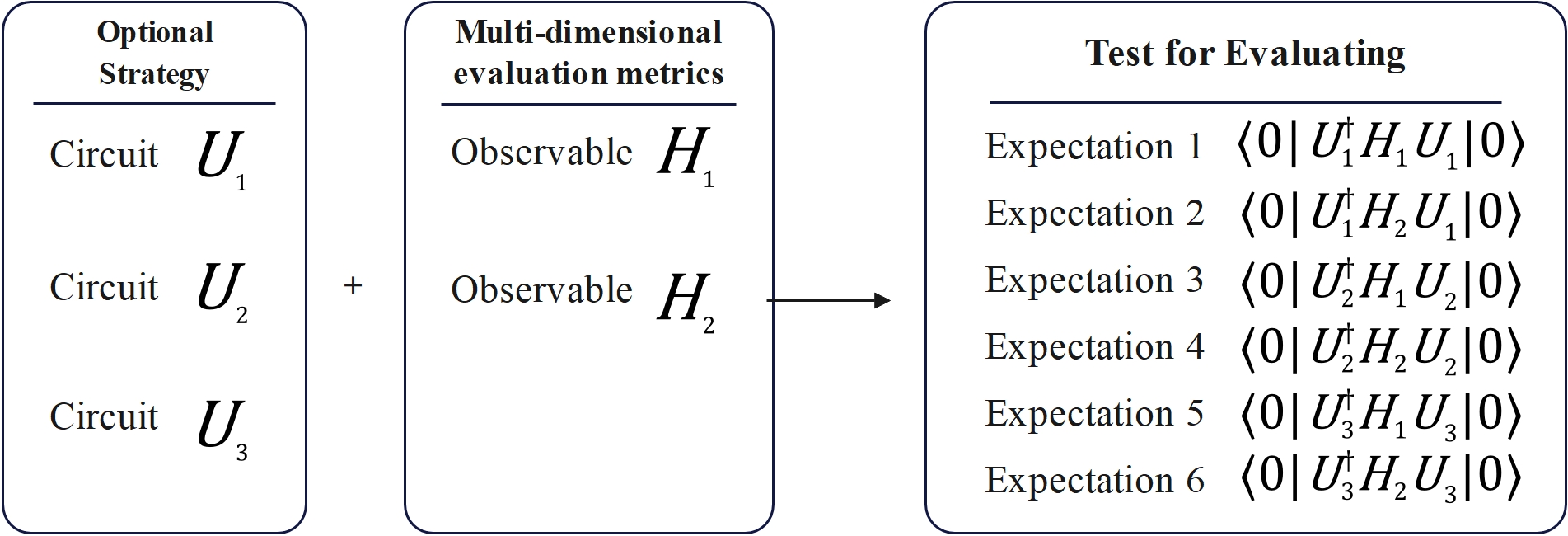
For more detailed information, please refer to ProgramSet
Example: n circuits + 1 observable#
# python code

from qpanda3_runtime import RuntimeService
from pyqpanda3.core import *
from pyqpanda3.hamiltonian import Hamiltonian

service = RuntimeService()
service.login('your_valid_api_key')
prog = QProg()
prog << X(0)<<CNOT(0,1)
prog2 = QProg()
prog2 << Y(1)<<CZ(1,0)
prog3 = QProg()
prog3 << Z(0)<<SWAP(0,1)
ham = Hamiltonian([('XZ', [0, 1], 3.14),('XZ', [0, 1], 1.14), ('ZY', [0, 1], 5.14)])
dev=service.device('72') # Here we use the quantum computing chip with id 72
task = service.estimate(
    ([prog,prog2,prog3],ham),
    dev,
)
res = task.get_result_sync()
print(f'res:{res}')
Example: n circuits + m observables#
# python code

from qpanda3_runtime import RuntimeService
from pyqpanda3.core import *
from pyqpanda3.hamiltonian import Hamiltonian
from qpanda3_runtime import CircuitObservableBinding

service = RuntimeService()
service.login('your_valid_api_key')
prog = QProg()
prog << X(0)<<CNOT(0,1)
prog2 = QProg()
prog2 << Y(1)<<CZ(1,0)
prog3 = QProg()
prog3 << Z(0)<<SWAP(0,1)
ham = Hamiltonian([('XZ', [0, 1], 3.14),('XZ', [0, 1], 1.14), ('ZY', [0, 1], 5.14)])
ham2 = Hamiltonian([('XZ', [0, 1], 1)])
ham3 = Hamiltonian([('ZY', [0, 1], 1)])
progs = [prog,prog2,prog3]
hams = [ham,ham2,ham3]
cir_obs = CircuitObservableBinding(progs,hams)
cir_obs.product([0,1,2],[0])
cir_obs.zip([2,1],[1,2])
dev=service.device('72') # Here we use the quantum computing chip with id 72
task = service.estimate(
    cir_obs,
    dev,
)
res = task.get_result_sync()
print(f'res:{res}')
Ways to Pass Quantum Circuits#
Supports passing quantum circuits as QProg/QCircuit/OriginIR
In the example code below, we define and submit an expectation estimation task with three circuits
The initial forms of the three quantum circuits are QProg object, QCircuit object, and OriginIR string respectively (This usage is not common, it’s only to demonstrate the related functionality)
Special attention needed:
In expectation estimation tasks, the qubits in the quantum circuit should be consistent with the qubits in the observable
The quantum circuit passed to the expectation estimation interface should not carry measurement nodes
# python code

from qpanda3_runtime import RuntimeService
from pyqpanda3.core import *
from pyqpanda3.hamiltonian import Hamiltonian

service = RuntimeService()
service.login('your_valid_api_key')
prog = QProg()
prog << X(0)<<CNOT(0,1)
cir = QCircuit()
cir << Y(1)<<CZ(1,0)
ir_str = '''
QINIT 2
CREG 1
Z q[0]
SWAP q[0],q[1]
'''
ham = Hamiltonian([('XZ', [0, 1], 3.14),('XZ', [0, 1], 1.14), ('ZY', [0, 1], 5.14)])
dev=service.device('72') # Here we use the quantum computing chip with id 72
task = service.estimate(
    ([prog,cir,ir_str],ham),
    dev,
)
res = task.get_result_sync()
print(f'res:{res}')
Ways to Pass Observables#
Supports passing observables as Hamiltonian/Pauli Operator/Hamiltonian string in the format supported by Origin Quantum Cloud
An example of the Hamiltonian string representation format supported by Origin Quantum Cloud is as follows:
"": -1.0534210769165204,"Z0": 0.394844363355904,"Z1": -0.39484436335590417,"Z0 Z1": -0.01124615715082114,
In the example code below, three expectation estimation tasks are executed, with observables passed as Hamiltonian/Pauli Operator/Hamiltonian string in the format supported by Origin Quantum Cloud
# python code

from qpanda3_runtime import RuntimeService
from pyqpanda3.core import *
from pyqpanda3.hamiltonian import Hamiltonian,PauliOperator

service = RuntimeService()
service.login('your_valid_api_key')
prog = QProg()
prog << X(0)<<CNOT(0,1)
ham = Hamiltonian([('XZ', [0, 1], 3.14),('XZ', [0, 1], 1.14), ('ZY', [0, 1], 5.14)])
pauliop = PauliOperator([('XZ', [0, 1], 3.14),('XZ', [0, 1], 1.14), ('ZY', [0, 1], 5.14)])
ham_str = '''
"": -1.0534210769165204,
"Z0": 0.394844363355904,
"Z1": -0.39484436335590417,
"Z0 Z1": -0.01124615715082114,
'''
hams = [ham,pauliop,ham_str]
dev=service.device('WK_C180') # Here we use the quantum computing chip with id WK_C180

for o in hams:
  task = service.estimate(
      (prog,o),
      dev,
  )
  res = task.get_result_sync()
  print(f'res:{res}')
Expectation Estimation Using FakeBackend#
For detailed information, please refer to FakeBackend
Step 1> Login#
# python code

from qpanda3_runtime import RuntimeService
from pyqpanda3.core import *

service = RuntimeService()
service.login('your_valid_api_key')
Step 2> Define the quantum circuit for expectation estimation#
# python code
# Continue from the previous example on this page
prog = QProg()
prog << X(0)<<CNOT(0,1)
Step 3> Define the observable for expectation estimation#
# python code
# Continue from the previous example on this page
from pyqpanda3.hamiltonian import Hamiltonian
ham = Hamiltonian([('XZ', [0, 1], 3.14),('XZ', [0, 1], 1.14), ('ZY', [0, 1], 5.14)])
Step 4> Select the device to execute the task#
In the example code below, dev is a limited simulation of the real quantum computing chip with id WK_C180, including:
Has the same qubit topology structure
Uses limited noise simulation with noise data (T1, T2, readout errors, etc.) from real quantum chip device specifications
# python code
# Continue from the previous example on this page
dev=service.device('WK_C180').fake_backend() # Here we use the Fake Backend corresponding to the quantum computing chip with id WK_C180
Step 5> Submit the task to Fake Backend#
When the backend device is Fake Backend,
RuntimeService.samplemust run in the__name__ == '__main__'environmentThe sampling calculation of Fake Backend is computed locally on the client
# python code
# Continue from the previous example on this page
task = service.estimate(
    (prog,ham),
    dev,
)
Step 6> Query the task execution result#
# python code
# Continue from the previous example on this page
res = task.get_result_sync()
print(f'res:{res}')
Step 7> Run On QPU#
If needed Submit the computing task data verified through Fake Backend to the corresponding real device for execution
# python code
# Continue from the previous example on this page
task2 = task.run_on_real_device(shots=1000)
res2 = task2.get_result_sync()
print(f'res2:',res2)
Complete Example Code#
# python code

from qpanda3_runtime import RuntimeService
from pyqpanda3.core import *
from pyqpanda3.hamiltonian import Hamiltonian

def est():
    service = RuntimeService()
    service.login('your_valid_api_key')
    prog = QProg()
    prog << X(0)<<CNOT(0,1)

    ham = Hamiltonian([('XZ', [0, 1], 3.14),('XZ', [0, 1], 1.14), ('ZY', [0, 1], 5.14)])
    dev=service.device('WK_C180').fake_backend() # Here we use the Fake Backend corresponding to the quantum computing chip with id WK_C180
    task = service.estimate(
        (prog,ham),
        dev,
    )
    res = task.get_result_sync()
    print(f'res:{res}')
    task2 = task.run_on_real_device(shots=1000)
    res2 = task2.get_result_sync()
    print(f'res2:',res2)

if __name__ == '__main__':
    est()